
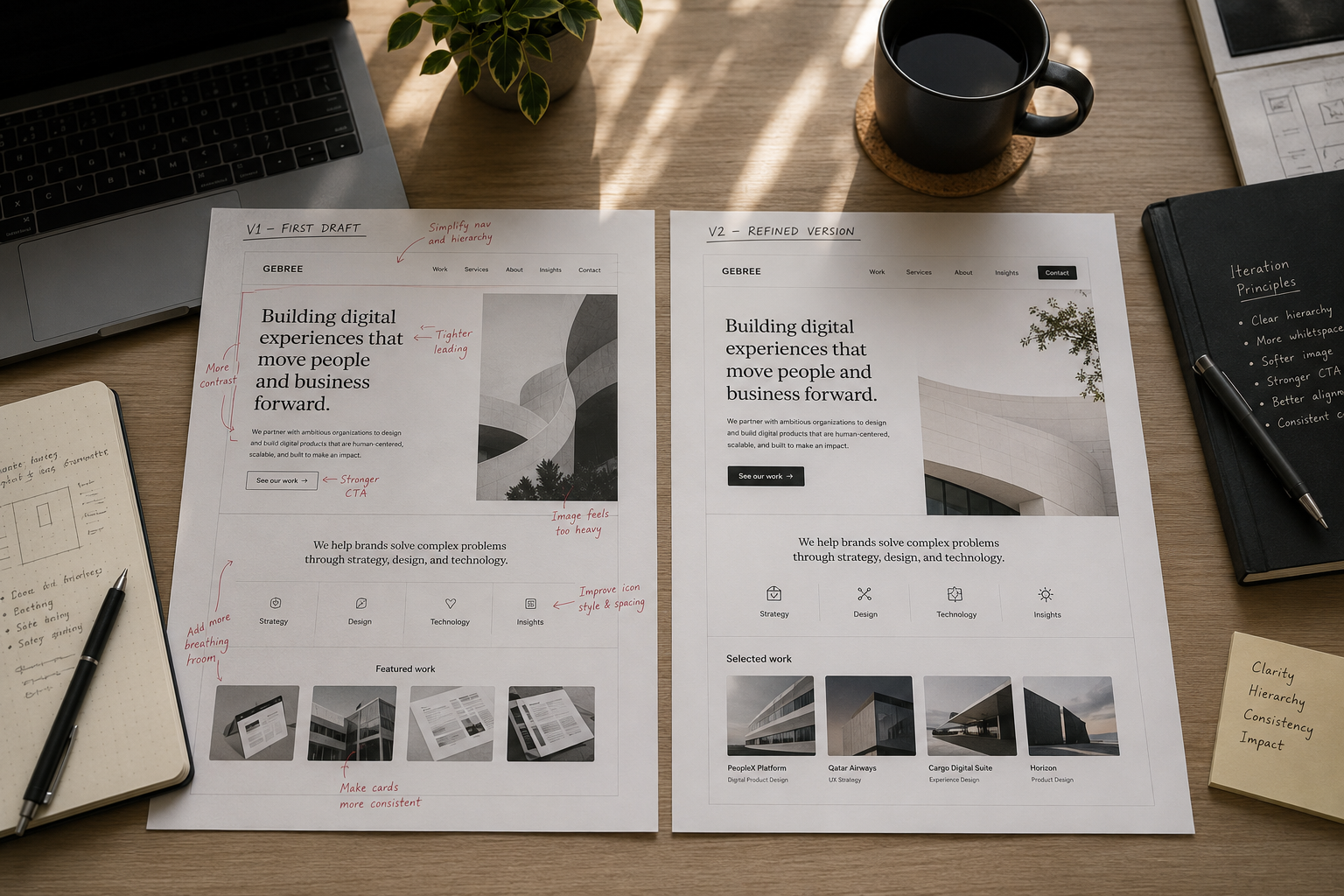
There is a moment in almost every project when the work begins to feel finished.
The presentation is polished. The design looks convincing. The strategy makes sense. The team has worked hard, and there is a natural desire to move forward.
That is often the moment when the most valuable work begins.
The first draft captures our current understanding. It reflects what we know, what we assume, and what we believe will work.
The second draft reflects what we have learned.
It comes after someone asks a difficult question. After a user struggles with something we thought was clear. After a stakeholder sees a risk we missed. After the team steps back and recognises that a better answer may still be possible.
The second draft is not simply a corrected version of the first.
It is often a more honest one.
The pressure to get it right the first time
In fast-moving organisations, confidence is often rewarded.
Leaders are expected to have answers. Designers are expected to present strong solutions. Teams are expected to move quickly and demonstrate progress.
There is little space for saying:
“We need to look at this again.”
Revisiting the work can be misunderstood as uncertainty, delay, or lack of preparation. As a result, teams sometimes defend an early idea long after evidence has started pointing elsewhere.
I have seen this happen in many forms.
A solution becomes attached to the person who proposed it. A design gains momentum because too much effort has already been invested. A business assumption is treated as fact because it has been repeated often enough. A polished prototype creates the impression that the thinking behind it must also be complete.
But good work does not become weaker when it is challenged.
It becomes clearer.
Listening without defending
One of the hardest professional skills is learning to receive feedback without immediately explaining the work.
Our instinct is often to defend the reasoning, clarify the context, or show why a decision made sense at the time.
Sometimes that explanation is necessary.
But when we respond too quickly, we may miss what the feedback is revealing.
The person giving feedback may not use the language of design. They may describe a symptom rather than the underlying problem. Their suggested solution may not be the right one.
Still, there is often something important beneath their reaction.
Confusion may reveal a problem with hierarchy. Resistance may point to a change-management concern. A repeated question may show that the journey is not as intuitive as we believed. Silence may suggest that people do not yet feel safe enough to challenge the direction.
Listening well means looking beyond the exact words and asking what they are helping us see.
That does not mean accepting every comment or designing by committee.
It means being confident enough to remain curious.
Research is an invitation to revise
User research has taught me that the first version of a problem is rarely the complete one.
A project may begin with a clear request: simplify a process, redesign a screen, introduce a feature, or improve adoption.
Once we speak to users, the situation often changes.
The problem may sit earlier in the journey. The requested feature may not address the real need. The process may be clear to the people who created it but confusing to everyone else. What appears to be resistance may actually be a lack of trust, confidence, or understanding.
Research does not always confirm our direction.
That is precisely why it matters.
Its value is not in helping us prove that the first draft was right. Its value is in giving us the evidence and courage to make the next draft better.
Some of the strongest decisions I have seen began with the willingness to say:
“What we believed at the start is no longer what we believe now.”
That is not failure.
That is progress.
Better work through shared ownership
The second draft is rarely created by one person alone.
It improves when different perspectives are allowed into the work.
Designers may see experience gaps. Engineers may identify technical realities. Operational teams may understand the pressures of the environment. Business leaders may see consequences beyond the immediate product. Users bring the lived reality that no internal team can fully reproduce.
When these perspectives meet early and honestly, the work becomes more resilient.
But collaboration requires more than inviting people to a meeting.
It requires creating space for disagreement without turning it into conflict. It means separating the quality of an idea from the seniority of the person who suggested it. It means allowing the strongest thinking to emerge, even when it changes the original direction.
As a leader, I learned that my role was not to protect the first answer.
It was to protect the conditions in which a better answer could emerge.
The courage to remove
Improvement is not always about adding more.
Sometimes the second draft is better because something has been removed.
A feature that created more complexity than value.
A step that existed only because the process had always included it.
A message that explained too much because the experience itself was unclear.
A visual element that competed for attention.
A requirement that served the organisation but created unnecessary effort for the user.
Removing work can be difficult, particularly when people have invested time and energy in creating it.
But effort alone does not make something valuable.
Mature teams learn to let go of work that no longer serves the outcome. They understand that simplicity often comes after complexity, not before it.
The first draft shows what we can create.
The second draft shows what we are willing to leave behind.
Iteration as a leadership behaviour
Iteration is often described as part of the design process.
I believe it is also a leadership behaviour.
Leaders create the tone around being wrong, changing direction, and learning in public. When a leader treats every change as a failure, teams begin hiding uncertainty. They present only polished answers, avoid difficult questions, and continue with weak ideas because changing course feels unsafe.
When leaders show that revision is expected, something different happens.
People raise concerns earlier. Teams test assumptions before investing heavily. Feedback becomes less personal. Learning becomes part of delivery rather than something that happens after a problem appears.
This does not mean constantly reopening decisions or chasing perfection.
Progress still requires commitment.
The challenge is knowing when to move forward and when the evidence is asking us to pause.
Strong leadership is not the ability to remain certain at all times.
It is the ability to change with integrity when a better direction becomes visible.
The work people never see
The second draft is usually quieter than the first.
There may be no major announcement when a team simplifies a journey, removes an unnecessary feature, rewrites confusing content, or changes direction after research.
Users may never know how many versions existed before the final experience reached them.
They only know that it works.
That quietness can make iteration feel less celebrated than the original idea. We often recognise the launch, the presentation, or the finished product, but not the careful reconsideration that made it stronger.
Yet much of the value in good design lives in those unseen decisions.
In the question asked one more time.
In the assumption that was tested rather than accepted.
In the conversation that changed the team’s understanding.
In the willingness to begin again without losing momentum.
What the second draft has taught me
Across my career, some of the work I am most proud of did not come from getting everything right at the beginning.
It came from people caring enough to look again.
The second draft taught me that high standards and humility are not opposites. We can believe deeply in the work while remaining open to changing it. We can provide direction without pretending to know everything. We can move with confidence while leaving room to learn.
The goal is not endless refinement.
It is meaningful improvement.
There will always be pressure to finish, launch, and move on. But when the work matters, taking another thoughtful look can change more than the output.
It can improve the decision.
Strengthen the team.
Build trust.
And bring us closer to the experience people genuinely need.
The first draft may demonstrate our ability.
The second reveals our maturity.